A warm-up is a warm-up exercise before performing the main exercise, and aims to raise the physical condition from the level of daily life to the level of exercise. The effect of warm-up is to prevent injuries from exercise and to prepare the body and mind for the best performance.
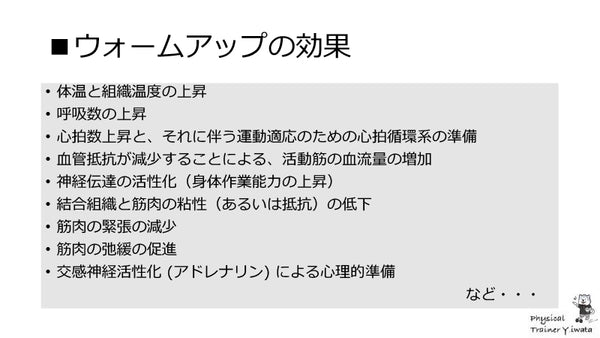
By warming up, your body temperature, heart rate, and breathing rate rise, and you are ready to deliver oxygen and nutrients to your whole body. By warming the body, the movement of joints and the flexibility of muscles can be drawn out, the effect of smoothing the movement of the main movement is created, and the risk of injury can be reduced.
As a factor to reduce the risk of injury, it is important not only to improve the flexibility of the body, but also to promote nerve transmission and activate the reaction speed (reflex speed) by performing warm-up exercises.
Also, if you feel very tense, such as before a sports match, doing some warm-up exercise will increase your heart rate by moving your body, rather than by doing tension. At sports sites, techniques such as "relieving tension" are sometimes performed along with slowing the heart rate by creating an illusion that is similar to being in the room. On the other hand, it is also effective when you are too calm before a match, and when you want to increase the excitement of your body and mind a little, adding a warm-up exercise will prepare not only your body but also your mind. will also be
■ Types of warm-ups
・Active W-UP: Warm up the body by exercising (jogging, exercise bike, etc.)
・Passive W-UP: Warming the body from the outside (e.g., taking a warm shower before exercise)
Passive warming up has the advantage of increasing body temperature without moving the injured area.
In the everyday sense, a warm-up is an activity that is done before playing sports, the purpose of which is to warm up the muscles. Muscles are highly viscous when cold and do not work smoothly, so one of the purposes is to increase muscle temperature and reduce viscosity.
■ Representative warm-up exercises
A warm-up is equivalent to very light exercise, where speed is not important, and you may walk, jog, or otherwise increase blood flow, circulation, and heart rate at a pace that may leave you slightly out of breath. If so, you are ready to go.
The degree of warm-up depends on the level and age of the person, maximum heart rate of 220 - 40-50% of the age for a minimum of 15 to 20 minutes of warm-up regardless of the outside temperature. It is believed that it is relatively safe to start exercising after doing it.

There are various ways to warm up, such as "strength training at a sports gym" and "preparation before participating in a sports competition", but starting the bench press, which is the main exercise, or starting practice without warming up. This puts a heavy burden on the tissues of the body and can lead to poor physical condition such as injuries and headaches. Let it warm up before starting.